
Introduction: The Evolving Landscape of Canadian International Education
The year 2026 marks a pivotal shift in Canada’s approach to international education. With the Immigration, Refugees and Citizenship Canada (IRCC) implementing strategic caps and revised eligibility criteria, the “Canada Dream” now requires more than just an offer letter—it requires a precision-based strategy.
Gone are the days when a simple diploma could guarantee a pathway to residency. Today, the Canada Study Visa 2026 process is about quality, labor market alignment, and financial stability. At Jaivik Overseas Consultants, we advocate for radical transparency, ensuring that Indian students are equipped with facts, not just expectations. This guide provides a deep dive into the 2026 regulatory framework for the Canada Study Visa 2026.
Decoding the 2026 International Student Cap
For the 2026 academic year, the IRCC has finalized a stabilized intake cap. Unlike the drastic fluctuations of previous years, the IRCC New Rules 2026 focus on “sustainable growth.” The goal is to ensure that the number of students entering the country matches the housing and healthcare capacity of the provinces.
The 155,000 Permit Target
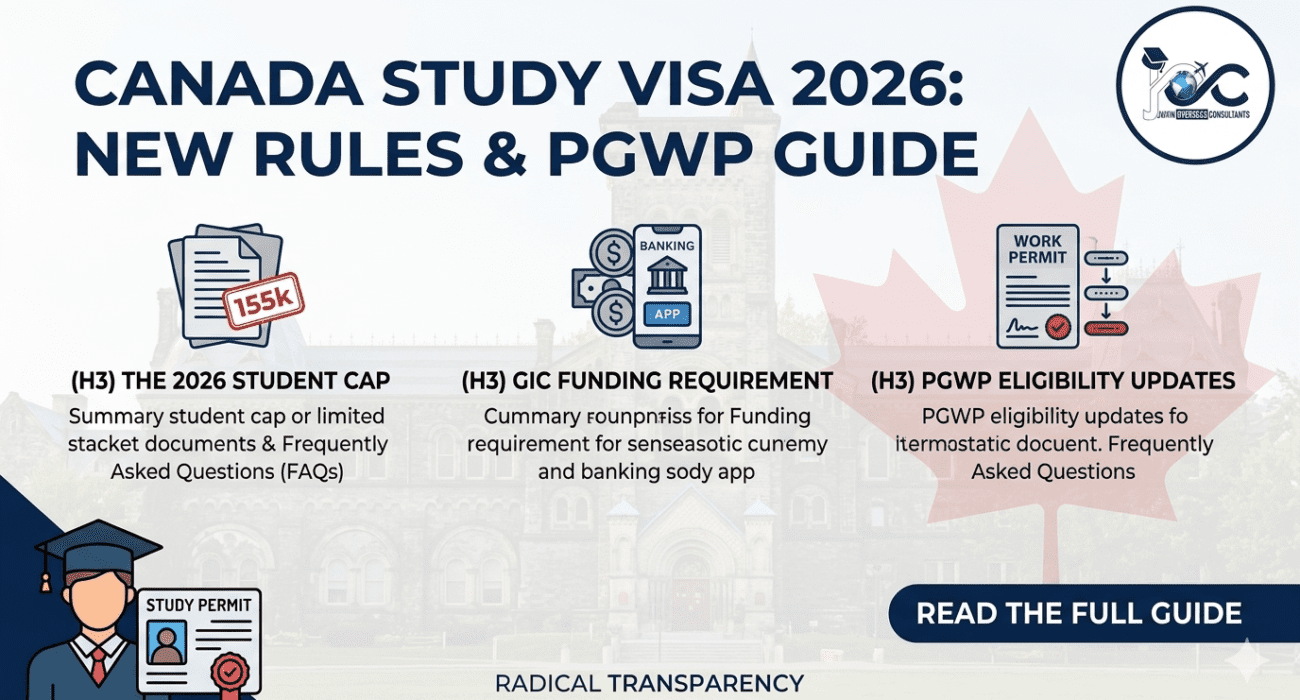
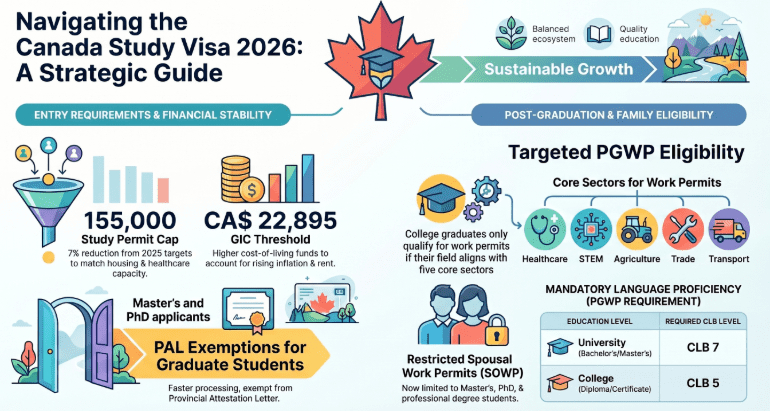
The Canadian government has capped the issuance of new study permits at 155,000 for 2026. This is a deliberate 7% reduction from the 2025 targets, directly affecting the Canada Student Visa Requirements for many applicants.
-
Impact on Applicants: Competition will be higher. Universities will prioritize students with high academic standing and strong financial backing.
-
Provincial Distribution: Permits are now distributed based on provincial population. This means Ontario and British Columbia, the most popular destinations, will have stricter quotas compared to Atlantic Canada (Nova Scotia, New Brunswick) or the Prairies (Saskatchewan, Manitoba). For Study in Canada for Indian Students, exploring these “under-represented” provinces might be the key to a faster visa approval.
Strategic Advantage: PAL and TAL Exemptions in 2026
One of the most significant updates for the Canada Study Visa 2026 is the introduction of the Provincial Attestation Letter (PAL) and Territorial Attestation Letter (TAL). However, not everyone needs it. Knowing these exemptions can save you months of waiting time.
Master’s and Doctoral Degree Students
Starting January 1, 2026, students applying for Master’s and PhD programs are officially exempt from the Provincial Attestation Letter (PAL) requirement.
-
Faster Processing: Since these students do not need provincial verification, their file processing time is significantly reduced under the IRCC New Rules 2026.
-
Strategic Move: If you are a graduate in India, we strongly recommend moving towards a Master’s degree rather than a PG Diploma. Not only is the visa success rate higher, but you also bypass the PAL queue.
-
Family Inclusion: Spouses of Master’s and PhD students remain eligible for the Spousal Open Work Permit (SOWP), making these the most lucrative programs for married applicants.
K-12 and Exchange Students
Younger learners in the K-12 category (Primary and Secondary school) remain exempt from the cap. This is a strategic pathway for parents looking to settle their children early in the Canadian education system.
Financial Requirements: The 2026 Canada GIC Update
To ensure students can sustain themselves amidst rising inflation, the Canada GIC Update has significantly adjusted the cost-of-living requirement.
-
GIC Threshold: The Guaranteed Investment Certificate (GIC) amount for a single applicant is now CA$ 22,895.
-
Why the Increase? The IRCC noticed that students were struggling with high rents in cities like Toronto and Vancouver. The new GIC ensures you have enough for food, rent, and insurance without over-relying on part-time jobs.
-
Total Financial Proof: When applying for the Canada Study Visa 2026, students must demonstrate the ability to cover the first year of tuition fees PLUS the Canada GIC Update amount.
-
Source of Funds: IRCC is now more scrutinizing regarding the “history” of funds. Unexplained large deposits 1-2 months before the application can lead to rejection under “Financial Non-Compliance.” At Jaivik Overseas, we help you prepare a solid financial narrative to avoid this.
Post-Graduation Work Permit (PGWP) Reforms 2026
The PGWP Eligibility 2026 is no longer a “given” for every graduate. This is perhaps the most critical change for Indian Students who plan to work in Canada after their studies.
Field of Study Requirements
Graduates from programs at the College level (Diplomas and Certificates) must now graduate from a field of study linked to long-term labour shortages to meet PGWP Eligibility 2026. IRCC has identified five core sectors that will receive work permits:
-
Healthcare: Nursing, Medical Lab Technology, and Pharmacy.
-
STEM (Science, Technology, Engineering, Math): Data Science, Cybersecurity, and Civil Engineering.
-
Agriculture and Agri-Food: Sustainable farming and food processing.
-
Trade: Electricians, Plumbers, and Skilled Construction workers.
-
Transport: Logistics and Supply Chain Management.
If your course does not fall into these categories and you are in a Diploma program, you might not get a work permit. This is why “Course Selection” is now more important than “College Selection.”
Language Proficiency for PGWP
A new mandatory requirement for PGWP Eligibility 2026 is the language test for all applicants at the time of graduation:
-
University Graduates (Bachelor’s/Master’s): Must prove a minimum CLB (Canadian Language Benchmark) 7.
-
College Graduates (Diploma/Certificate): Must prove a minimum CLB 5.
The Spousal Open Work Permit (SOWP) Restriction
The Spousal Open Work Permit (SOWP) is now restricted under the IRCC New Rules 2026.
-
Who can bring spouses? Only those in Master’s, PhD, or professional degrees (Medicine, Law, Nursing).
-
Undergraduate Impact: Students enrolled in Bachelor’s or Undergraduate Diploma programs can no longer bring their spouses on an Open Work Permit. This is a move intended to reduce the strain on the Canadian housing market and prioritize high-skilled talent.
Step-by-Step Application Process for 2026
To ensure your Canada Student Visa Requirements are met, follow this 2026 roadmap:
-
Selection of DLI: Choose a Designated Learning Institution (DLI) that is PGWP-eligible.
-
Admission and LOA: Secure your Letter of Acceptance (LOA) early (at least 8 months before intake).
-
Provincial Attestation: Obtain your Provincial Attestation Letter (PAL) (if you are in the undergraduate stream).
-
GIC Payment: Transfer the CA$ 22,895 as per the Canada GIC Update.
-
Medical and Biometrics: Complete these upfront to avoid delays.
-
Visa Filing: Submit your application via the IRCC secure portal. Make sure your Statement of Purpose (SOP) reflects “Radical Transparency” about your career goals.
Frequently Asked Questions (FAQs)
Q1: Is it still worth going to Canada in 2026?
Ans. Absolutely, but only if you choose a course that has a high labour market demand. Canada is prioritizing “Economic Immigrants,” so if you have the right skills, your path to PR is actually clearer now.
Q2: Can I study in Canada without a PAL in 2026?
Ans. Yes, only if you are applying for a Master’s, PhD, K-12, or an exchange program. All other undergraduate applicants require a Provincial Attestation Letter (PAL).
Q3: What is the success rate for Canada Study Visa 2026?
Ans. The success rate for “genuine” students with strong financial and academic backgrounds remains above 80%. Rejections happen mostly due to poor course selection or lack of financial clarity.
Q4: Will the GIC amount increase again?
Ans. The Canada GIC Update is reviewed annually. For 2026, it is CA$ 22,895, and it’s likely to remain stable for this intake cycle.
Conclusion: Navigating the 2026 Intake with Jaivik Overseas
Canada remains a premier destination for global education, but the margin for error has disappeared. The new rules for Canada Study Visa 2026 demand professional expertise and an honest assessment of your profile.
At Jaivik Overseas Consultants, located in the heart of Ghaziabad, we don’t just process visas—we build careers. We provide the Radical Transparency you need to succeed in your Study in Canada for Indian Students journey.
Don’t gamble with your future. Secure your 2026 intake with the right guidance.
Explore detailed university and course information on our Study Abroad Portal: study.jaivikoverseasconsultants.com