For thousands of Indian students, the dream is clear — complete a degree abroad and transition to permanent residency. Canada remains the most popular destination for this pathway. However, getting Canada PR after study in 2026 requires a strategic, long-term plan that begins before you even receive your offer letter. This complete step-by-step guide from Jaivik Overseas Consultants, Ghaziabad maps out every stage of the journey.
Related Reading: Complete list of PGWP eligible colleges in Canada 2026 | Canada Student Visa 2026 Guide | Canada vs Australia 2026
The Canada Student to PR Pathway — Overview
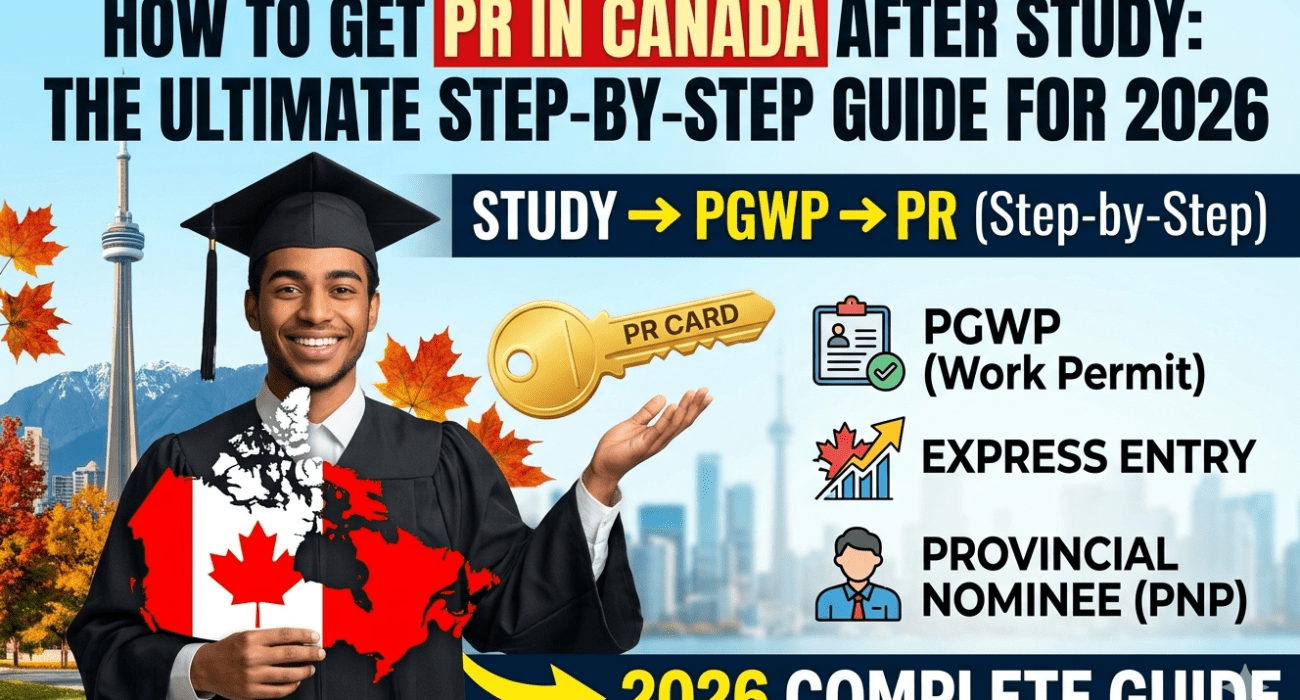
The most common route: Study → PGWP → Canadian Work Experience → Express Entry PR. This typically takes 4–6 years from the time you start your degree to receiving PR. With Canada’s tighter 2026 rules, each stage requires more strategic planning than before.
Step 1 — Choose the Right Program (NOC TEER Category Matters)
Not all Canadian degrees lead to PR with equal ease. Your program must align with NOC TEER 0, 1, 2, or 3 occupations — the categories eligible for Express Entry. Highest-demand fields in Canada’s 2026 labour market:
- 💻 Software Development and IT — NOC TEER 1, strong Express Entry scores
- 🏥 Healthcare — Nursing, Pharmacy, Allied Health — critical shortage, provincial nominees available
- 🏗️ Engineering — Civil, Mechanical, Electrical — consistent demand
- 📊 Finance and Accounting — CPA Canada pathway for international students
- 📚 Education — teacher shortages in many provinces
Step 2 — Get Your Student Visa Approved
Before anything else, you need to get into Canada. With a 74% national rejection rate in 2025, this is harder than before. Read our complete Canada Student Visa 2026 guide to understand exactly what makes a successful application in the current environment.
Step 3 — Score High on IELTS (CLB 9 Target)
Your IELTS score determines your CLB level which directly impacts your CRS score. For competitive Express Entry draws in 2026, CLB 9 (IELTS 7.0 in each band) is the recommended target. Read our Canada PR IELTS score guide for the complete CLB-to-CRS conversion. Check your current level with our Free IELTS Mock Test.
Step 4 — Choose a PGWP-Eligible Institution
This is the most critical step Indian students miss. Your program must be at a PGWP-eligible institution — a Designated Learning Institution (DLI) approved for PGWP. Not all DLIs are PGWP-eligible since the January 2024 changes.
We have compiled the complete verified list of PGWP eligible colleges and universities in Canada 2026 — covering Ontario, BC, Alberta, Manitoba, Nova Scotia, and Saskatchewan. Key institutions include:
- ✅ Ontario: Conestoga, Humber, Seneca, George Brown, Sheridan, Fanshawe, Durham, Georgian, Lambton, Algonquin, Mohawk, University of Windsor, Trent, University of Ottawa
- ✅ British Columbia: Thompson Rivers University, Kwantlen, Capilano, VCC, UNBC, Royal Roads, SFU, UBC Okanagan
- ✅ Alberta: SAIT, Bow Valley, Concordia Edmonton, Red Deer Polytechnic
- ✅ Nova Scotia: Dalhousie, Acadia University, Cape Breton University
- ✅ Manitoba: University of Winnipeg, Assiniboine College, University of Manitoba
See our PGWP eligible colleges complete guide with application fee waiver info and best picks for Indian students.
Step 5 — Apply for PGWP After Graduation
The Post-Graduate Work Permit (PGWP) allows you to work in Canada for up to 3 years after graduation. Key 2026 rules:
- Program must be at least 8 months long for any PGWP
- 2-year program = 3-year PGWP (most strategic choice)
- Program must align with NOC TEER 0-3 occupations (new requirement)
- Masters and PhD students get PGWP equal to program length regardless of field
- Apply within 180 days of graduation
Read our complete Canada PGWP 2026 guide for full eligibility rules and application process.
Step 6 — Gain Canadian Work Experience (1 Year Minimum)
For Canadian Experience Class (CEC) eligibility, you need at least 1 year of full-time skilled work experience in Canada in a NOC TEER 0, 1, 2, or 3 occupation within the 3 years before your PR application. This is why choosing the right NOC-aligned program from Step 1 is so important.
Step 7 — Enter Express Entry Pool and Receive ITA
Once you have your PGWP, Canadian work experience, and a strong IELTS score, you enter the Express Entry pool. Your CRS score determines how quickly you receive an Invitation to Apply (ITA) for PR. 2026 draw averages: CEC draws around 480–520 CRS; FSWP draws at 500+. A CLB 9 IELTS score, Canadian degree, and 1 year work experience typically gives CRS of 470–510 — competitive for most draw types.
Step 8 — Submit PR Application
After receiving your ITA, you have 60 days to submit a complete PR application. Processing time: approximately 6 months. Also consider Canada vs Australia PR comparison before finalizing your destination.
Canada PR Timeline — Realistic Estimate for 2026
| Stage | Duration |
|---|---|
| Preparation + visa approval | 6–12 months |
| Study in Canada (2-year program) | 2 years |
| PGWP work period | 1 year minimum (up to 3 years) |
| Express Entry + ITA wait | 6–18 months |
| PR application processing | 6 months |
| Total from start to PR | 4–6 years |
Use our Country Comparison Tool to compare Canada PR timeline vs UK and Australia side by side.
Start Planning — Free Counselling at Crossing Republik
Students from Crossing Republik, Indirapuram, Vaishali, Raj Nagar Extension, and Noida — get your complete Canada PR roadmap in a free session with Gaurav Katyal.
📍 333 Orbit Plaza, Crossing Republik, Ghaziabad 201016
📞 +91 99712 26347
🌐 Book Free Counselling Online
🕐 Monday to Saturday: 10 AM – 7 PM
Find Your Canada PR Pathway University on Our Portal
Compare all PGWP-eligible universities — real acceptance rates, fees in INR, and PR pathway analysis: