


Introduction: The Illusion of “Easy” Permanent Residency
Every year, thousands of international students board flights to Sydney, Melbourne, and Brisbane with a singular dream: securing an Australian Permanent Residency (PR). They envision a life of high-paying jobs, world-class healthcare, and a powerful passport. However, the landscape of Australia PR in 2026 is vastly different from what it was five years ago.
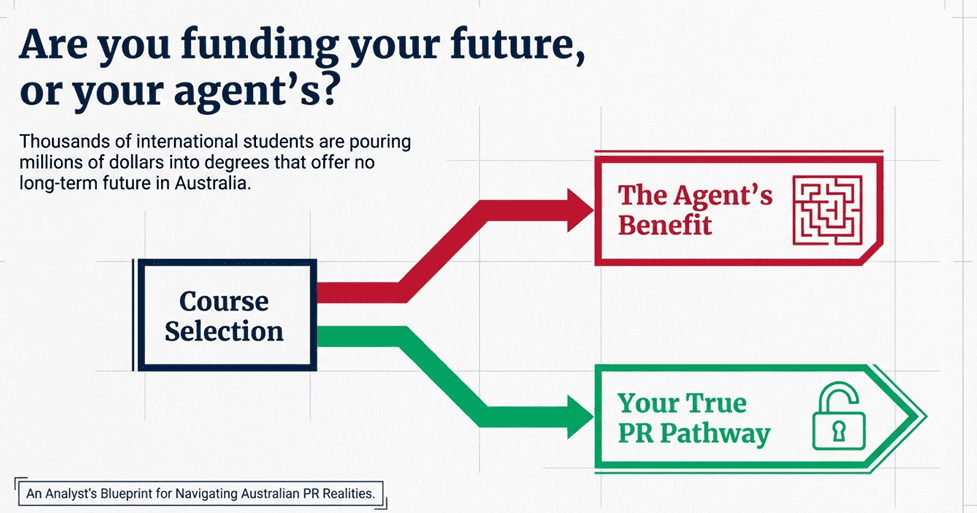
Before you sign that offer letter or pay your tuition deposit, you must pause and ask a critical question: Are you choosing a course based on your genuine career aspirations, or are you simply being steered into a “commission-heavy” course by an education agent?
At Jaivik Overseas Consultant, we see a recurring pattern. Students arrive in our Ghaziabad office after spending lakhs of rupees on degrees that have zero demand in the current Australian job market. The “PR dream” is being sold as a commodity, but the reality is a complex calculation of the Australia PR Points System, policy shifts, and English proficiency.
The “Agent Trap”: Why Your Consultant Might Be Misleading You
To understand why so many students end up in “dead-end” courses, you have to understand the business of international education. Many agents receive higher commissions for enrolling students in specific private colleges or “popular” trade courses.
The Push for “Easy” Admissions
Agents often push courses like Accounting or Commercial Cookery because they are easy to process. There are hundreds of providers, the entry requirements are often lower than specialized degrees, and the “PR pathway” story is easy to sell. But an “easy admission” often leads to a “difficult PR” in the long run.
The Myth of the “Fixed” PR List
Agents often show students the Medium and Long-term Strategic Skills List (MLTSSL) as if it’s a menu. They imply that if a course is on the list today, you are guaranteed a visa in three years. This is a dangerous half-truth. The Australian government updates the Skilled Occupation List 2026 based on real-time economic data. What is “in demand” during your first semester might be “oversupplied” by the time you graduate.

Exposing the Myths: The “Popular” Courses Under Fire
Let’s perform a deep-dive “reality check” on the three most common best courses for PR in Australia that students often choose for the wrong reasons.
1. Accounting: The “Professional Year” Deception
For a long time, the Professional Year (PY) was a staple for Accounting students, giving them an extra 5 points toward their PR. Recently, the removal of certain PY requirements has been marketed by agents as a “fast-track” to residency.
The Reality Check: The government didn’t remove the requirement to help you; they removed it because the market is saturated. In 2026, the Points Test for Accountants is incredibly high. Often, candidates need 95 to 100 points just to receive an Invitation to Apply (ITA). Unless you have a perfect PTE for PR score, a NAATI CCL certification, and regional study points, an Accounting degree alone is no longer a golden ticket.
2. ICT Business Analyst: The Saturation Point
The “Tech Boom” led thousands into Business Analytics and ICT Systems courses. While Australia still needs tech talent, it needs specialized talent.
-
The Gap: There is a massive surplus of “Generalist” Business Analysts who only know the theory.
-
The Data: With limited vacancies nationwide and tens of thousands of graduates, the competition is brutal. If you aren’t specializing in Cybersecurity, Cloud Computing, or AI Integration, you are just another face in a very large crowd.
3. Commercial Cookery: The “Chef” Pathway Scrutiny
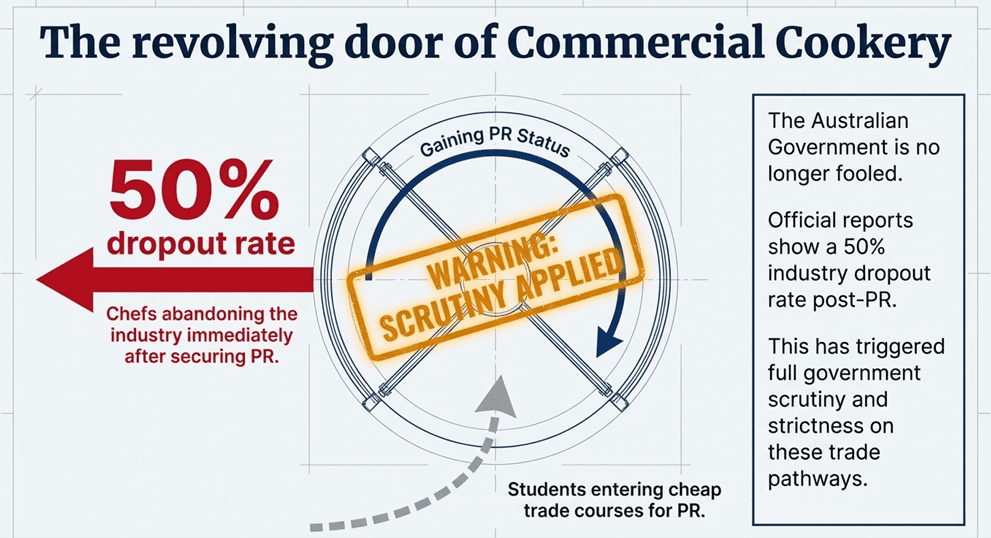
Trade courses have always been seen as the “budget” way to PR. However, the Department of Home Affairs has identified a “visa-hopping” trend where students receive a PR as a Chef and then immediately leave the kitchen.
The Result: The 2026-2027 migration strategy includes Strict Scrutiny on trade assessments. You now need to prove genuine, long-term employment in the industry to satisfy the requirements for a Subclass 190 visa or 491 visa.
The High-Demand Sectors: Where the PR is Actually Hiding
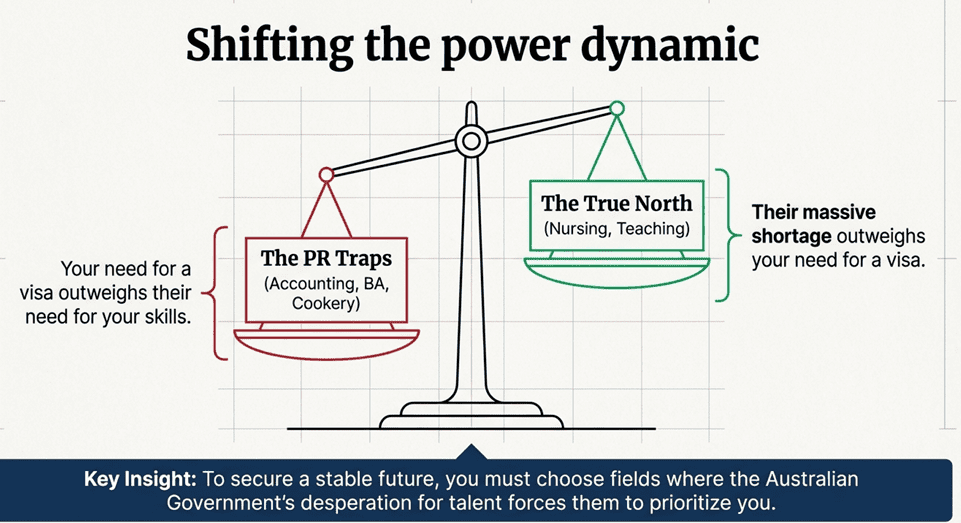
If you want the Australian government to want you, you must fill a gap that they cannot fill themselves. In 2026, these are the priority sectors for Australia PR.
Nursing and Healthcare
Nursing PR pathway remains the “invincible” choice. Whether it is Registered Nursing (Aged Care) or Mental Health Nursing, the shortage is so severe that invitations are often sent out within weeks of submitting an EOI (Expression of Interest).
-
Location Advantage: Unlike other fields, Nurses can get PR while living in prime cities like Sydney or Melbourne.
Secondary and Early Childhood Education
Australia is facing a demographic crisis in education. Teachers, particularly in Special Education and Early Childhood, are in desperate demand. If you have a passion for teaching and strong English skills, this is currently the most secure “Low-Point” PR pathway available for study in Australia 2026.
Civil Engineering and Construction Trades
With the “Housing for All” initiative, the need for civil engineers and licensed electricians is at an all-time high. These careers offer a direct bridge to permanent residency through employer-sponsored visas.
The “Hidden” Success Factor: The Australian Employment Gap
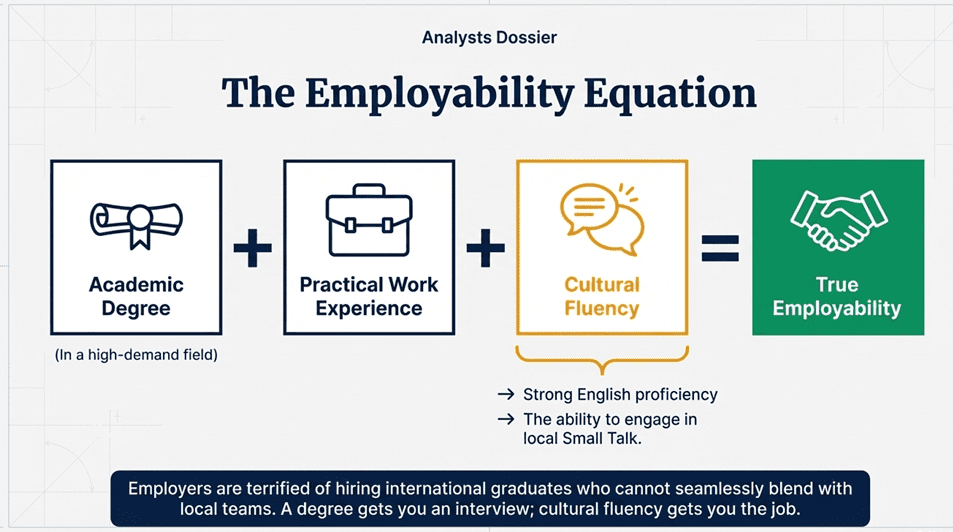
Many students focus 100% on their degree and 0% on their employability. This is where most international students fail.
Why Employers Hesitate
An Australian employer cares about:
-
Communication Skills: Can you explain a complex problem clearly?
-
Cultural Fit: Do you understand “Aussie Workplace Culture”?
-
Local Experience: Have you done an internship or local part-time work in your field?
Pro Tip: Your PR journey starts the day you land. Improve your IELTS/PTE until it is native-level. This is worth more than any degree.
For More Information Visit Here – https://www.youtube.com/watch?v=Jns8Nl_3b4E
How to Build a “Points-Proof” Profile for 2026
To secure PR, you must maximize your score in the Australia PR Points System. Here is the checklist we use at Jaivik Overseas:
-
Age (25–32 years): 30 points.
-
English (Superior): 20 points.
-
Education (Bachelor’s/Master’s): 15 points.
-
Regional Study: 5 points.
-
NAATI CCL: 5 points.
-
Partner Skills: 5-10 points.
3 Golden Rules for International Students
-
Trust Data, Not Hearsay: Always verify claims on the official Department of Home Affairs website.
-
Invest in Yourself: Choose a course you love. Passion leads to employer sponsorship (Subclass 186/482).
-
Start Early: Rules for Australia PR 2026 change quickly. Don’t wait until your 485 visa is expiring.
Conclusion: Secure Your Future, Not Just an Admission
Your education is a massive investment. Don’t gamble it on a “popular” course that might be obsolete. Look at the data, focus on high-demand sectors like Nursing and Teaching, and improve your skills every day.
Book Your Expert Consultation with Jaivik Overseas
At Jaivik Overseas Consultant, led by Gaurav Katyal, we pride ourselves on “Radical Transparency.” We don’t sell dreams; we build career roadmaps based on the latest 2026 immigration data.
[Book your consultation right now] and take the first step towards a secure future in Australia.

Frequently Asked Questions
Q1: Is Accounting a good course for getting Australia PR in 2024?
Answer: No, Accounting is currently not a recommended course for PR Many agents claim that the removal of the Professional Year makes it easier, but the reality is the government removed it because the market demand for Accounting is almost zero and enrollments were heavily falling
Q2: Why are agents warning against the ICT Business Analyst course?Answer: The job market for ICT Business Analysts has shrunk drastically in Australia. Currently, there are only about 1,700 job vacancies available across the entire country . Unless you are a master in coding or analytics, taking this course just for a visa is a huge risk . Q3: Are Commercial Cookery (Chef) courses still an easy pathway to PR?
Answer: No, they are no longer an easy pathway. The Australian government is now applying strict scrutiny to trade courses Official reports show that 50% of international students abandon the chef profession immediately after receiving their PR, which has led the government to become very strict with these applications Q4: Which courses offer the easiest PR pathways in Australia right now ?
Answer: Fields like Nursing and Teaching currently offer the best pathways for PR There is a massive shortage of professionals in these sectors, meaning you can easily secure a job and PR even in prime cities like Sydney and Melbourne, without having to struggle in smaller regional areas
Q5: Why do Australian employers hesitate to hire international students, even with a degree?Answer: Australian employers often hesitate because many international graduates struggle with weak English and find it difficult to make “small talk” or blend into the local work culture To get hired, your practical skills and communication abilities are just as important as your degree
Find Real Australia PR-Pathway Courses on Our Portal
Browse genuine nursing, teaching, and engineering courses at Australian universities — with real fees in INR and 485 visa eligibility confirmed: